

Commercial sensor taps in Australia must carry WaterMark certification and a WELS rating, and in accessible washrooms they should suit AS 1428.1 reach and operation requirements. Choose mains or battery power by site, add thermostatic mixing (45°C maximum in healthcare and aged care), and match spout reach to the basin.
Most specification advice treats sensor taps as a water-saving add-on. That undersells them. In a public, healthcare or accessible washroom, a hands-free tap is a hygiene control and an access feature first, and a water saver second.
This guide is written for builders, plumbers, architects, facility managers and procurement teams. It covers compliance, power options, scald safety, basin matching and a handover checklist, using the accessible and sensor tapware (care mixer) approach we apply at Avail Designs. Always confirm final requirements against the current standards and your certifier.
Key takeaways
- Sensor taps remove the need to grip, twist or pinch, which helps users with arthritis, limited dexterity or reduced strength.
- Touchless operation reduces the number of shared surfaces a user touches, which matters in healthcare, aged care and high-traffic public washrooms.
- Every tap you specify needs WaterMark certification and a WELS rating. Confirm both on the product documentation, not just the brochure.
- In healthcare and aged care, delivery temperature must be limited to 45°C under AS/NZS 3500.4. Specify thermostatic mixing as part of the tap package.
- Power choice (mains or battery), sensor range and shut-off timing should be matched to traffic and user needs, not left to defaults.
- Spout reach and basin clearances decide whether an accessible tap works in practice. Confirm dimensions against the current edition of AS 1428.1.
Summary Table
| Decision area | What to check | Why it matters |
|---|---|---|
| Certification | WaterMark licence and WELS registration | Legal compliance and certifier sign-off |
| Accessibility | Reach, operation and basin clearances under the Australian Standard for accessible design | Usable by people with limited grip, reach or mobility |
| Power | Mains or battery, and how each is serviced | Reliability and maintenance load |
| Sensor behaviour | Detection range, shut-off timing, adjustability | Comfort for slower users and control of water waste |
| Temperature | Thermostatic mixing and the healthcare delivery limit | Scald protection for vulnerable users |
| Durability | Robust body, concealed fixings, easy-clean surfaces | Resistance to misuse in high-traffic sites |
| Handover | Calibration record, manuals, maintenance schedule | Smooth operation after practical completion |
Why do sensor taps suit commercial and accessible washrooms?
Sensor taps suit commercial and accessible washrooms because they work without grip, twist or pinch force, reduce the surfaces users touch, and stop water running when hands are removed. That combination supports users with limited dexterity, lowers cross-contamination risk and cuts waste in busy sites.
Hands-free operation for limited grip and dexterity
Conventional taps ask a lot of a hand. A user must grip a handle, apply force and often rotate the wrist. For someone with arthritis, a hand injury, tremor or weak grip, that is a daily barrier.
According to the Australian Bureau of Statistics (Survey of Disability, Ageing and Carers, 2022), about one in five Australians has disability. Washrooms in workplaces, clinics and public buildings serve that population every day, whether or not the room carries an accessible sign.
A sensor tap removes the handle from the equation. The user moves their hand into the detection zone and water flows. No force, no grasp.
Reduced cross-contamination
A tap handle is a touch point. Users touch it with dirty hands before washing, then touch it again with clean hands to turn it off. Touchless operation breaks that loop.
In healthcare and aged care, where infection control is already a priority, fewer shared touch points is a sensible design choice. It does not replace hand hygiene practice or cleaning routines. It removes one avoidable risk from the room.
Taps left running
In busy public sites, taps get left on. Push-button and lever taps depend on the user to turn them off. Sensor taps shut off when the hand leaves or after a set time. For a facility manager, that means fewer flooded benchtops, lower water bills and fewer complaints.
A short scenario
Consider a residential aged care facility where several residents have arthritis. Staff notice residents skipping handwashing in their ensuite basins because the existing handles are stiff and hard to turn. The facility replaces them with sensor care mixers, set to a limited delivery temperature. Residents wash hands independently, staff spend less time assisting, and there is no handle to wipe down between users. This is a hypothetical example, but it reflects the reasoning behind specifying sensor tapware in care settings.
What compliance do commercial sensor taps need in Australia?
Commercial sensor taps need WaterMark certification as a plumbing product, a WELS registration and rating, and, in accessible washrooms, a design that supports the operation and reach expectations of AS 1428.1. Check each on documentation before the product is ordered, because certifiers will ask for it.
WaterMark certification
WaterMark is the mandatory certification scheme for plumbing and drainage products in Australia. It is administered under the Australian Building Codes Board framework and ties into the Plumbing Code of Australia, part of the National Construction Code.
In practice, a tap installed in a building should be WaterMark certified and marked accordingly. Ask suppliers for the certificate or licence details and keep a copy in the project file. If a supplier cannot produce one, do not specify the product.
A word of caution for plumbers: a product that is certified for one application is not automatically certified for every application. Read the scope of the certification against how the tap will be used.
WELS ratings
The Water Efficiency Labelling and Standards (WELS) scheme requires taps to be registered and labelled with a star rating. More stars means lower water use for a given product category. Flow rate and star rating are listed on the WELS register and on product labelling.
For commercial specifiers, WELS matters in two ways. First, it is a legal requirement for supply. Second, many project briefs and green building targets reference water efficiency. Choose a rating that suits the brief, then check that the flow still feels adequate to users, because a very low flow can frustrate people who need extra time at the basin.
AS 1428.1 and accessible basins
AS 1428.1 sets design requirements for access and mobility in buildings. For basins, it addresses how tap controls are operated and where they sit relative to the user. The core principle is that controls should be usable with one hand and without tight grasping, pinching or twisting of the wrist. Sensor operation meets that intent well.
Reach and clearance are where projects go wrong. A sensor tap is only accessible if the user can position their hand in the detection zone from a seated or standing position, with knees clear under the basin.
Always confirm dimensions against the current edition of AS 1428.1 and the Disability (Access to Premises, Buildings) Standards, and agree interpretation with your access consultant or certifier. We do not quote clearances here because editions and project conditions change.
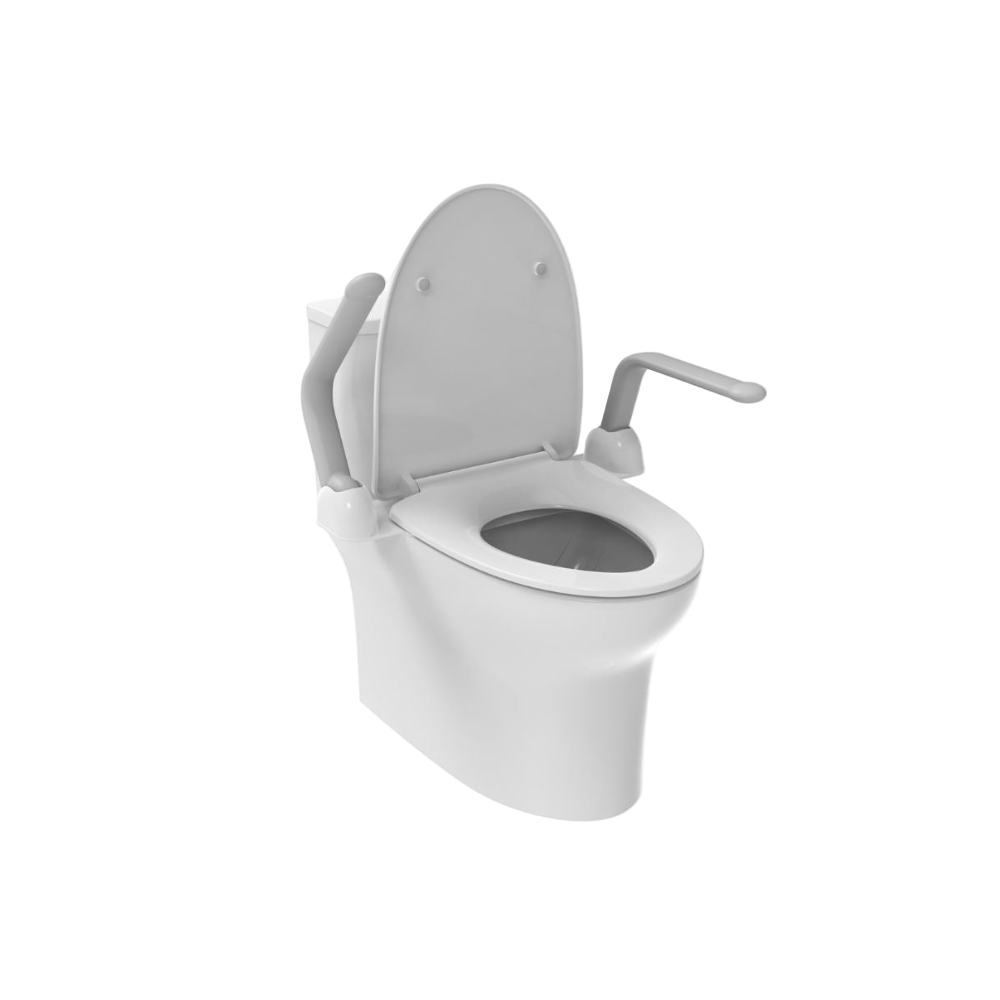
On related fixtures, the standard sets grab rail mounting height at 800mm to 820mm above the finished floor. Rails near basins should be planned alongside the tap and basin so they do not block reach.
Mains or battery: how do you choose power and sensor settings?
Choose mains power where a licensed electrician can run a compliant supply and you want low routine maintenance. Choose battery operation where retrofitting power is costly or disruptive. In both cases, check sensor range, shut-off timing and build robustness against the traffic the washroom will see.
Mains versus battery operation
| Factor | Mains-powered | Battery-powered |
|---|---|---|
| Best suited to | New builds and major refurbishments | Retrofits and sites where wiring is difficult |
| Installation | Needs a compliant electrical supply and licensed electrical work | Simpler install, no new wiring |
| Ongoing maintenance | Low, but needs electrical fault response | Regular battery checks and replacement |
| Failure mode | Power outage stops operation | Flat battery stops operation |
| Planning need | Coordinate with electrician early | Set up a battery replacement schedule |
Neither is better in every case. A well-run facility with a maintenance schedule handles batteries easily. A site with poor maintenance follow-through is often better served by mains power. Be honest about which describes your client.
Sensor range
Detection range determines how reliably the tap responds without false triggers. Too short and users wave their hands in frustration. Too long and the tap runs when someone reaches past it or when the basin is being cleaned.
For accessible use, the sensor should respond to a hand in a natural position, including a slower or less precise hand movement. Check whether the range is adjustable on the model you choose, and confirm that from the product data sheet rather than assuming.
Auto shut-off timing
Auto shut-off prevents water waste if something is left in the detection zone. The trade-off is that a short timer can cut off water on users who work slowly. Where the model allows adjustment, set timing with the slowest likely user in mind, not the fastest.
Vandal resistance for high-traffic sites
Public washrooms, schools, transport hubs and sports venues take abuse. When specifying for these sites, look for a solid body, concealed or tamper-resistant fixings and surfaces that wipe clean easily. Ask the supplier what the product is designed to withstand. Do not assume "commercial" means "vandal resistant".
How do you keep sensor taps safe from scalding?
Pair sensor taps with thermostatic mixing so delivered water stays within safe limits. Under AS/NZS 3500.4, healthcare and aged care facilities must limit hot water delivery at the outlet to a maximum of 45°C. Specify the mixing device, the tap and the commissioning check as one package.
Why scald safety needs extra attention
Vulnerable users may have reduced sensation, slower reflexes or difficulty moving away from hot water. A hands-free tap adds one more consideration: the user may not be adjusting a handle, so there is no tactile feedback on temperature. Water just arrives at whatever temperature the system supplies.
That makes upstream temperature control essential. The tap should never be the only safeguard.
Specifying thermostatic mixing
Thermostatic mixing valves blend hot and cold supply to hold a set outlet temperature, even if pressures fluctuate. Tempering and mixing devices used in Australian plumbing should be appropriately certified, and thermostatic mixing valves are tested to AS 4032.1. Confirm the product certification with your plumber and the manufacturer.
Sensor mixers with a preset or limited temperature range suit care settings, because they remove the choice of a scalding setting. Check how each model handles temperature, and confirm that the overall system, including any separate mixing valve, delivers the required outlet temperature at the point of use.
Commissioning and testing
Do not rely on the label. Measure delivered temperature at the outlet during commissioning, record the result and repeat it at scheduled intervals. Temperatures drift over time as valves wear or supply conditions change. A care facility should treat this as a routine check, not a one-off.
How do you match sensor taps to accessible basins?
Match the tap to the basin by checking spout reach, detection zone position and the clearance beneath a wall-hung basin. The user's hand should reach the sensor comfortably from a seated or standing position, and water should land in the bowl, not on the rim.
Spout reach and water placement
Spout reach is the horizontal distance from the tap body to where water falls. If the reach is too short, water hits the back of the bowl and splashes. If it is too long, it can overshoot the drain and wet the user's clothing or the floor.
For accessible use, a longer reach brings the water and the sensor zone closer to the user. That reduces how far a seated user must lean. Pair the tap with a basin whose bowl depth and shape suit the spout, and check the combination on the manufacturer's dimensions.
Clearances under wall-hung accessible basins
Wall-hung basins give wheelchair users space to roll in. Knee and toe clearance beneath the basin matters, and so does the waste and trap arrangement. A bulky trap in the wrong place defeats the clearance.
Because dimensions are set in the standard, confirm them against the current edition of AS 1428.1 and the manufacturer's installation drawings. Plan the plumbing rough-in before the wall is lined, not after.
Placement within comfortable reach
A tap and sensor positioned at the front of the basin are easier to reach than ones at the back. Consider the user who cannot lean forward. Consider also the user who stands but has limited shoulder movement.
Check the position of any nearby grab rail. A rail that sits in the sweep of the arm can block access to the tap, or it can support a user while they wash. Planning both together avoids rework. If you are also fitting out showers in the same facility, treat the basin and shower zones as one accessible design, and cross-check against an AS 1428.1 compliance checklist.
What belongs on an installation and maintenance checklist?
A good checklist covers sensor calibration, battery replacement, filter cleaning and handover documentation. Do these at installation and on a schedule afterwards. Most sensor tap complaints trace back to calibration drift, dirty filters or flat batteries, not to the tap itself.
Installation
- Confirm WaterMark and WELS documentation before ordering and file copies.
- Check the basin, rough-in and clearances against the current AS 1428.1 and manufacturer drawings.
- Flush supply lines before connecting the tap, so debris does not block the filter or solenoid.
- Install thermostatic mixing as specified and record the commissioned outlet temperature.
- Calibrate sensor range at the installed basin, with the surrounding finishes in place. Reflective surfaces can change sensor behaviour.
- Test shut-off timing and adjust where the model allows.
Ongoing maintenance
- Sensor calibration: recheck after cleaning or any change to the basin surround.
- Battery replacement: set a recurring calendar reminder rather than waiting for a failure. Replace batteries in a group on a schedule.
- Filter cleaning: inline filters collect debris. Clean them at intervals set by the manufacturer, and sooner if flow drops.
- Temperature checks: retest outlet temperature in care settings as part of routine compliance.
- Cleaning: use non-abrasive products that suit the finish, and keep the sensor window clear.
Handover documentation
Give the facility manager a single pack: certification copies, product manuals, the commissioning temperature record, the calibration settings, the maintenance schedule and supplier contact details. Without it, the next plumber starts from zero.
Why a sensor-only tap is not always the accessible choice
The usual advice is that more automation means more accessibility. I do not fully agree. A sensor tap helps people who struggle with handles, but it can fail the people it is meant to serve if it is specified carelessly.
Three problems come up repeatedly in specification reviews. First, the sensor zone can be hard to find for a user with a tremor, low vision or limited reach. If the hand has to be held precisely in a small zone, the tap is not truly hands-free for that person. Second, a short auto shut-off can cut off water before a slower user has finished. Third, a flat battery or a power fault leaves a sensor-only tap with no fallback at all.
My position is that accessible sensor tapware should be judged on the user's worst day, not the average one. Ask three questions of any model before you specify it. Can the sensor range and timing be adjusted? Is the temperature controlled upstream so the user never has to make a choice? What happens when the power or battery fails, and who fixes it?
If the answers are vague, choose a different model. The aim is a basin that someone with arthritis, a tremor or a wheelchair can use without help, every time. Water savings are a bonus, not the brief. The care mixer approach, combining reliable sensor operation with controlled temperature, is built around that thinking. When you are unsure, involve an occupational therapist or access consultant before the order goes in.
Next Step
Browse Avail Designs' sensor and care mixer range, or contact the team for help specifying compliant tapware and matching accessible basins for your next commercial project. Tell us the building type, user group and basin layout, and we will help you narrow the options.
References
- Australian Government, Water Rating (WELS scheme)
- Australian Building Codes Board, WaterMark Certification Scheme and Plumbing Code of Australia
- Standards Australia, AS 1428.1 Design for access and mobility and AS/NZS 3500.4 Plumbing and drainage: Heated water services
- Australian Bureau of Statistics, Disability, Ageing and Carers, Australia: Summary of Findings


